The Punjab sun, and what it means for your house
Most of Punjab sits close to 31.6° north. That one number decides how high the sun climbs over your house, and so how much heat and light each wall and window receives through the year.
Two angles worth knowing
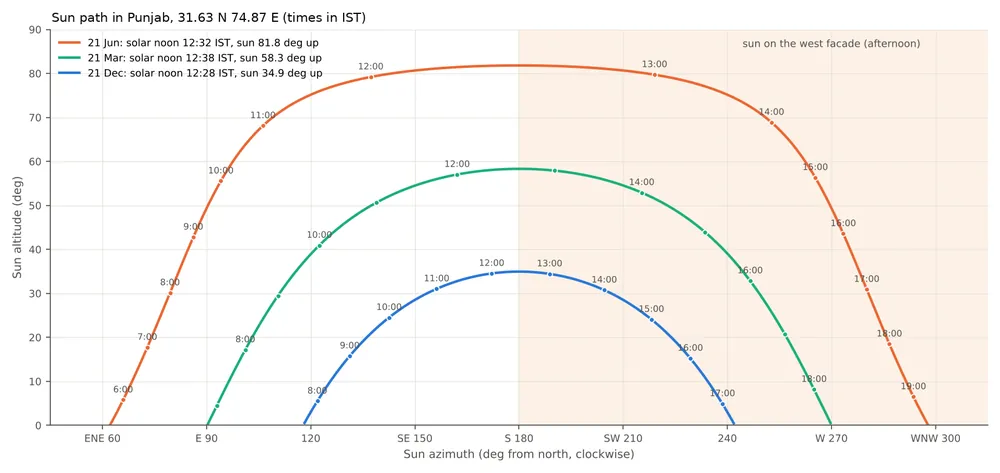
The height of the noon sun is 90° minus your latitude, plus the sun's tilt for that day. On 21 June the tilt is +23.4°, so the noon sun stands at 90 − 31.6 + 23.4 = 81.8°, almost overhead. On 21 December the tilt is −23.4°, so it stands at only 34.9°, low in the southern sky.
What that means in practice
South windows are the easy ones. Because the summer sun is so high at noon, a modest overhang over a south window blocks it, while the low winter sun still reaches deep into the room. A useful rule: the overhang depth is the window height divided by tan of the June angle, which at 81.8° is small.
West is the hard one. Summer afternoons bring sun from the west and north-west at low angles, which overhangs cannot stop. West glass needs vertical fins, a jaali, a deep verandah or simply less glass.
Courtyards work twice. A narrow, tall court stays shaded for most of a June day and acts as a cool well of air at night, while a wider court lets the December sun reach the floor. The proportion of the court is a choice you can calculate, not guess.
The roof takes the most heat. With the sun near overhead in June, the roof receives more sun than any wall. Insulation above the slab and a light-coloured finish usually matter more than anything you do to the walls.
How we use it
For every design we draw the sun path for the plot's own latitude, test each window and court against it, and run a simple comfort check for the hottest and coldest weeks. You can see this on both of our design projects, where every shade and court size comes from these two angles.